AZERBAIJAN’S DIPLOMATIC HERITAGE: FROM NATIONAL STATEHOOD TO INTERNATIONAL LEGITIMACY
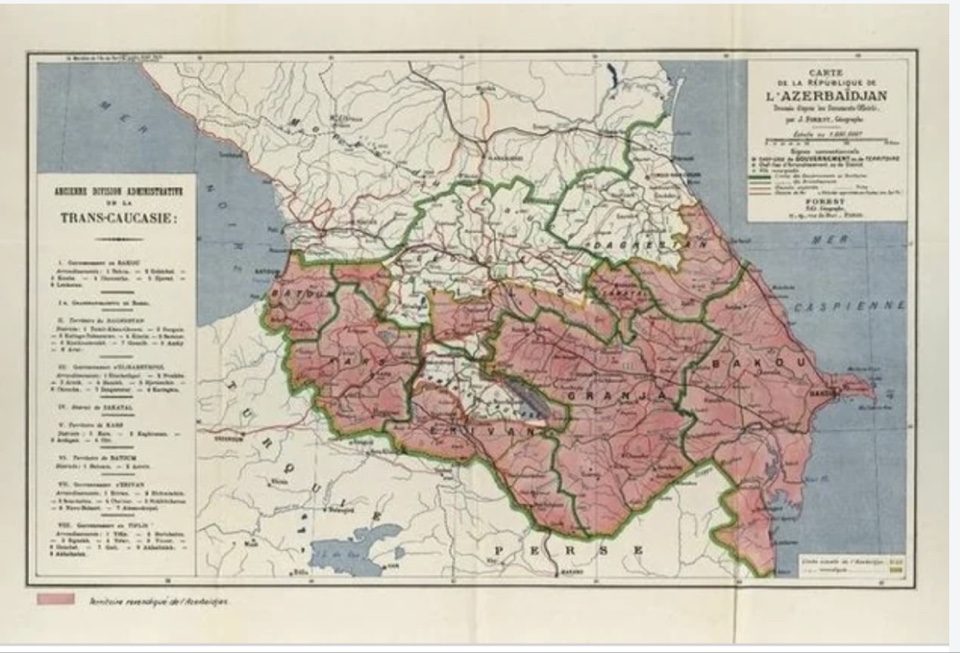
108 years have passed since the establishment of the Azerbaijan Democratic Republic.
This constitutes a significant milestone in the historical evolution of Azerbaijani statehood and reflects the enduring trajectory of the national idea of sovereignty within the broader continuum of political development.
Within this historical framework, the strategic policy directions implemented by the contemporary Azerbaijani state—including the consolidation of national defense capabilities, the institutional development of modern diplomacy, and the expansion of regional and international cooperation—have substantially contributed to the strengthening of Azerbaijan’s position within the global system of international relations. Consequently, modern Azerbaijan has both preserved the continuity of its historical statehood traditions and adapted its foreign policy to the complex and evolving conditions of contemporary geopolitical realities, thereby forming a flexible, multidimensional, and interest-oriented diplomatic strategy.
Established in 1918, the Azerbaijan Democratic Republic represents one of the most pivotal political achievements in the constitutional and state-building history of Azerbaijan. Furthermore, it occupies a distinguished place in the political development of the Muslim East as one of the earliest examples of a parliamentary republic grounded in modern democratic principles. The Azerbaijan Democratic Republic introduced a state governance model based on the principles of the rule of law, popular sovereignty, and national independence, thereby inaugurating a new stage in the political modernization of the region.
During its brief yet substantively significant period of activity, the Azerbaijan Democratic Republic (ADR) identified the protection of national interests within the international system as a priority direction and undertook important measures toward the establishment of independent and credible state institutions. At the same time, the foreign policy pursued by the ADR made a substantial contribution to securing Azerbaijan’s international legitimacy and laying the foundations of its national diplomatic tradition.
The proclamation of the Azerbaijan Democratic Republic is regarded not only as a landmark in Azerbaijani political history, but also as a pivotal turning point in the broader processes of state-building and political modernization in the region, marking the establishment of the first parliamentary democratic republic in the Muslim East.
The primary priority of the ADR’s foreign policy strategy was to ensure international legitimacy and achieve recognition of Azerbaijan as a subject of international law. Operating in a highly complex geopolitical environment, the Azerbaijani government viewed the sustainability of state independence as being directly dependent not only on the formation of domestic governance institutions, but also on the attainment of international political support and diplomatic recognition, and therefore treated this as a strategic priority.
The dispatch of a special delegation to the Paris Peace Conference in 1919 represented one of the most significant diplomatic initiatives of ADR foreign policy. The main objective of the Azerbaijani delegation was to present Azerbaijan’s independence to the international community, substantiate the country’s strategic and political importance in the region, and secure formal recognition by major world powers.
The delegation was led by the distinguished intellectual, jurist, diplomat, and Speaker of Parliament, Alimardan bey Topchubashov, who played a crucial role in defending Azerbaijan’s political position on the international stage. During diplomatic and political engagements in Paris, he consistently advocated for Azerbaijan’s independence on legal grounds, emphasizing its democratic governance model and seeking to demonstrate its readiness to act as a reliable actor in the international system of relations.
The delegation also included prominent political and public figures of the time such as Mammadhasan Hajinski, Ahmad bey Aghayev, Akbar agha Sheikhulislamov, Miryagub Mehdiyev, and other influential intellectuals. Drawing upon their diverse political and intellectual experience, these representatives carried out important diplomatic activities aimed at ensuring the international representation of the Azerbaijan Democratic Republic, defending its political and legal position, and presenting Azerbaijan as an independent state within the international community.
The Azerbaijani delegation held numerous diplomatic meetings in Paris with political representatives of the United States of America, the United Kingdom, France, and other Entente Powers. During these negotiations, particular emphasis was placed on the fact that the Azerbaijan Democratic Republic was an independent and sovereign state, that it occupied a significant geostrategic position in the South Caucasus region, that it was founded upon democratic principles of governance, and that it could play an important role in ensuring political stability in the region. In addition, the delegation brought to the attention of the international community that Azerbaijan held particular importance in terms of regional security and political balance as a counterweight to Bolshevik expansion.
As a result of sustained diplomatic activity and political negotiations, on 11 January 1920, the Supreme Council of the Entente Powers granted de facto recognition to the Azerbaijan Democratic Republic. This decision is regarded as a major historical event in terms of the partial acceptance of the ADR’s legal and political legitimacy within the international system. At the same time, this recognition is considered one of the most significant international-political achievements of Azerbaijani diplomacy within a relatively short period.
The prominent Azerbaijani intellectual and historical figure Alimardan bey Topchubashov was one of the key leaders of the diplomatic efforts aimed at securing international recognition of the Azerbaijan Democratic Republic. In the negotiations conducted in Paris, Topchubashov consistently defended Azerbaijan’s national interests and worked toward the acceptance of the country as a legitimate political subject within the international relations system as an independent state. His diplomatic activity played an essential role in shaping the foreign policy strategy of the ADR and in its broader struggle for international legitimacy.
The Ottoman Empire was among the first states to recognize the Azerbaijan Democratic Republic. The Treaty of Batum, signed on 4 June 1918, constitutes one of the earliest official international documents establishing the legal foundations of political and diplomatic relations between the two states. This agreement held particular political significance in terms of the ADR’s integration into the international system of relations.
The presence of diplomatic missions of the United States of America, the United Kingdom, France, Italy, and other states in Baku during 1919–1920 constituted one of the key indicators of Azerbaijan’s growing international political and geostrategic significance. These diplomatic engagements demonstrated the Azerbaijan Democratic Republic’s active efforts to participate in the system of international relations and its gradual recognition as an important actor in the regional political landscape.
Fathali Khan Khoyski noted that “Azerbaijan’s independence must be defended not only domestically but also in the international arena.” This perspective reflects the core of the ADR’s foreign policy concept, underscoring the inseparable link between the preservation of state independence and active diplomatic engagement at the international level.
Despite its brief 23-month existence, the Azerbaijan Democratic Republic established a significant institutional legacy in the history of statehood and diplomacy. The political and diplomatic experience of the ADR made an important contribution to the formation of the fundamental principles of modern Azerbaijani diplomacy, including the defense of national interests, international cooperation, multilateral diplomacy, and the concept of statehood grounded in international law.
In the contemporary period, the Republic of Azerbaijan has further developed these principles, strengthening its status as a reliable partner at both global and regional levels. The country’s foreign policy is based on a pragmatic approach, the reconciliation of mutual interests, and the principle of sovereign equality, thereby ensuring a balanced and multi-vector diplomatic strategy within the international system.
At the same time, Azerbaijan actively participates in international organizations and demonstrates an initiative-driven stance in promoting regional stability and cooperation. Modern Azerbaijani diplomacy, drawing upon its historical traditions of statehood, has formed a strategically adaptive foreign policy model capable of responding flexibly to evolving geopolitical realities.
Prof.Dr.Nushaba MAMMADOVA
Presizent & Founder International Dialogue and Development Allliance